by Stephanie Sporkin
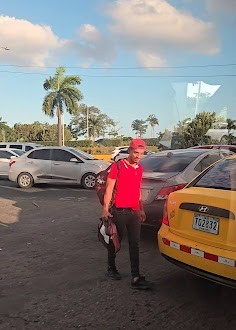
A pedestrian in Panama City crosses a street between cars in heavy traffic.
Panama has become a popular travel destination, and I enjoyed my recent visit to this tropical city. Road safety is always a priority when I travel, and Panama City offered some interesting perspectives about safely navigating the city. With a population of approximately 1.15 million citizens, Panama City has experienced several decades of rapid growth and expansion. Traffic is often heavy, and the city’s infrastructure has not kept pace with the needs of its expanding population. Recently modernized roads offer safe options for pedestrians, cyclists, and scooter riders, but there are many areas still in need of updating and repair.
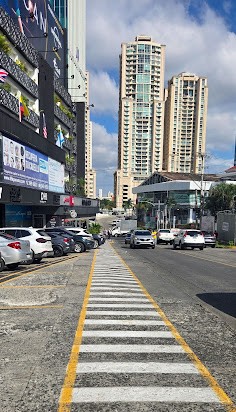
A crosswalk shares space with parking areas in downtown Panama City.
The Vehicular Traffic Regulations of the Republic of Panama Transit and Land Transport Authority list vehicle speed limits in city traffic to between 40 to 60 kph (25 and 37 miles per hour). Pedestrians are instructed to use sidewalks, pedestrian paths, and overpasses and are advised to walk on the left side of the road facing oncoming vehicular traffic when other options are unavailable. While there are detailed traffic regulations, drivers can be aggressive and may not follow the rules of the road.
Crossing certain busy intersections or side streets could be challenging. Many streets in the business areas lack sidewalks, and available sidewalks are often narrow or uneven and in need of repair. The area in front of stores or office buildings is often used for parked vehicles, and pedestrians and cyclists are forced to navigate these limited spaces. There are well-marked crosswalks on many streets, but the driving culture does not allow for pedestrians’ right of way. Often, the only way I was able to cross a heavily trafficked side street was to make eye contact with the driver and proceed slowly until the driver came to a complete stop. On numerous occasions, I witnessed pedestrians unsafely navigating crowded intersections between vehicles.
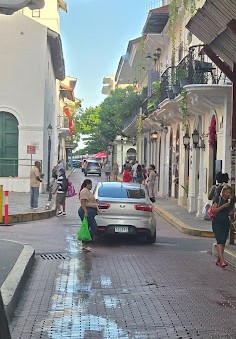
Pedestrians navigate narrow streets and sidewalks in historic Casco Viejo.
An area of the city with potential challenges for pedestrians is the charming historic section of Panama City, Casco Viejo (also known as Casco Antiguo or San Felipe). This small neighborhood, a designated UNESCO World Heritage Site, was settled in 1673 after pirates destroyed the original city. Casco Viejo attracts multitudes of tourists to its quaint cafes, upscale shops, high-end restaurants, local craft stands, and stunning architecture. Sidewalks in this area are extremely narrow, and crowds of visitors often walk in and across the narrow streets congested with vehicles. While sightseeing in this unique area, I was careful to remain on the walkways and exercised caution when crossing the streets.
Several public transportation options exist to navigate Panama City. The city’s Metro de Panamá is the first and only rapid transit system in Central America. The routes are comprehensive, and while I did not have the opportunity to travel by Metro, the trains are described as clean, comfortable, air conditioned, reliable, and affordable. Metro trains run frequently and offer travelers an easy way to get to and from the airport.
Rideshare is also popular with tourists in Panama City. Uber, the most commonly used rideshare option, is widely available. I used Uber multiple times and found it an efficient and inexpensive way to travel. There are other options for rideshare, as well as yellow taxis for which fares need to be negotiated upon entering the vehicle since rides are not metered.
A trip to Panama City would not be complete without a visit to the impressive Panama Canal. The Canal’s Miraflores Visitor Center is a 20-minute trip outside the city and can be accessed via car or tour bus and public transportation. Panama City is a fascinating and worthwhile destination. Be sure to learn about its roads and ways to travel safely while planning your trip.
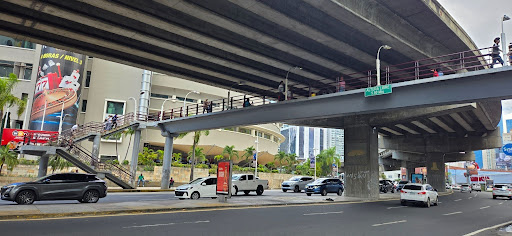
An overpass enables pedestrians, cyclists and scooter riders to safely cross a heavily trafficked road in Panama City.
ASIRT collects, analyzes and produces comprehensive road safety information for travelers in the form of country-specific Road Safety Reviews (RSR) for approximately 90 countries, including Panama. For more information on accessing individual country reports or an ASIRT subscription, please visit asirt.org/resources or contact [email protected] or 240-249-0100.
Stephanie Sporkin is the Director of Communications and Technology for ASIRT.